
What actually convinces a customer to try new global flavors is authenticity
For product developers, brand strategists, and beverage marketers, the lifecycle of a viral food trend often looks like a high-speed sprint followed by a sharp drop-off. However, category data increasingly reveals a clear divergence between short-lived social fads and sustainable market shifts.
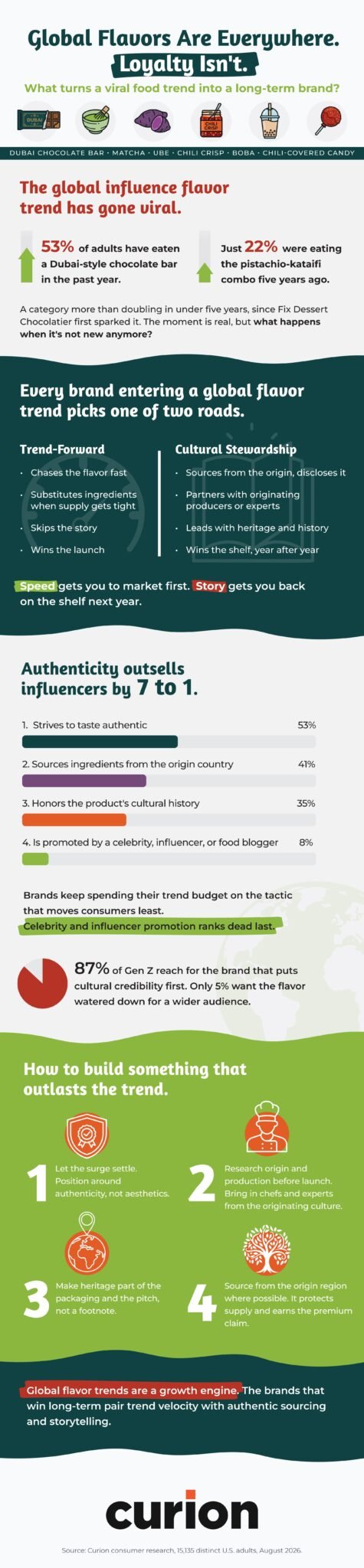
According to a nationwide study of more than 15,000 U.S. adults conducted by product research firm Curion, consumer adoption of global flavor trends and profiles, such as matcha, boba, and pistachio-kataifi formulations—is moving into durable, long-term territory. Crucially for CPG teams, authentic taste (53%) and origin-based ingredient sourcing (41%) outperform celebrity and influencer endorsements (8%) by nearly seven to one as primary purchase drivers. For Gen Z consumers, 87% report a strong preference for brands that prioritize cultural origin and transparent heritage over quick-turn adaptation.
For beverage innovators and brand builders evaluating product roadmaps, the takeaway is clear: market staying power relies on verifiable provenance and sensory integrity, not superficial algorithmic momentum.
Read the complete findings and press release below:
Global Flavors Have Gone Mainstream and New Curion Research Finds Authenticity — Not Influencers — Is What Makes Them Last
CHICAGO — September 16, 2026— Global flavors have moved from niche to mainstream, and with that a proliferation of copycats hit the market quicker than ever. New research from Curion, a consumer insights and product research firm with more than 50 years of experience, finds that consumers in the long term are choosing the brands they trust to deliver an authentic, quality product. And it’s not just the taste of the product that counts, it’s the story of how it first materialized, where it’s coming from, how it’s produced, and how it’s positioned.
In a Curion Poll PULSE survey of more than 15,000 U.S. adults, 87% of Gen Z are most likely to reach for a brand that puts cultural acknowledgements first, by sourcing ingredients from the origin country as a highlight of quality, honoring the history of the product while layering in their own storytelling, and striving to taste authentic. Meanwhile only 5% of Gen Z and 8% of all surveyed adults mention they’d rather brands sacrifice authenticity to make themselves more palatable to a wider audience.
The survey also found 53% said they had eaten a “Dubai-style” chocolate bar — the chocolate, pistachio and crisped-kataifi confection popularized by Fix Dessert Chocolatier — in the past year. Five years ago, just 22% reported regularly eating treats built on that same flavor combination. The category has more than doubled in under five years, and it is not alone: matcha (44%) and boba, or bubble milk tea (48%), each reached a broad share of consumers in the past year after a decade of steady growth.
What actually convinces a consumer to try
Asked what would convince them to buy a new product with globally inspired flavors, consumers pointed to the product itself, not the marketing around it. The strongest drivers were a product that strives to taste authentic (53%), one that highlights the quality of its ingredients (43%), and one that sources ingredients from the country of origin the product is tied to (41%). Honoring the product’s cultural history (35%) and explaining the inspiration behind it (33%) followed close behind.
Celebrity, influencer, chef and food-blogger promotion ranked at the very bottom of the list, named by just 8% — meaning authentic taste swayed consumers nearly seven times as often as a celebrity or influencer endorsement. Only 12% said they would want a brand to adapt a flavor for a wider audience at the expense of authenticity.
Consumers investigate before they buy
Consumers are also more deliberate about trends than the pace of social media might suggest. Only 14% said they ignore cultural food trends. Far more engage actively: the most common posture was comparison shopping, with 40% seeking out several brands’ versions of a trending product to compare. Roughly a third said they search out the original product that started the trend (32%), try a single version to satisfy their curiosity (32%), or research which brands are most authentic to a product’s origins (30%). About one in four (27%) said they look into a product’s cultural background whether or not they end up buying it.
Two roads into a trend
Curion’s analysis frames a choice every brand face when a global flavor goes viral. A trend-forward approach chases the flavor quickly, substitutes ingredients when supply tightens and leads with aesthetics. This is a path that can win the launch. A cultural-stewardship approach sources from the origin, discloses it, partners with originating producers and leads with heritage marks a slower path that tends to win over the consumer year after year.
The decision about what path to take is real. Surging demand has strained supply chains, from a widely reported pistachio shortage tied to the “Dubai-style” chocolate boom to pricing and availability pressure on Japanese matcha. But the research suggests brands that treat a trend as a durable category, rather than a limited-time novelty, are better positioned as a flavor moves from new to normal.
“The trend is real, and it isn’t going away — but ‘new’ is a temporary advantage. Speed gets you to market first; authenticity is what gets you back on the shelf next year,” said Isabelle Huang, associate director, strategic product insights for Curion. “Our data shows consumers reward the product, not the hype. Authentic taste and quality ingredients move people to try something far more than any celebrity or influencer does.”
The brands that are still selling when a global flavor stops being novel are the ones that did the work up front — understanding where a flavor comes from, sourcing it with integrity and telling that story honestly.
What it means for brands
The findings point to a clear playbook for brands weighing whether and how to enter a global-flavor trend:
● Treat the flavor as a category, not a limited-time offer. Consumption of established global flavors keeps climbing year over year; the durable opportunity is in staying, not sprinting.
● Lead with the product. Authentic taste and ingredient quality are what move consumers to try — well ahead of influencer or celebrity promotion, which ranks last.
● Build cultural credibility into the product, not the footnote. Sourcing from the origin, honoring the history and explaining the inspiration all rank among the top reasons consumers say they would buy.
● Source from the origin region where feasible. It strengthens both supply-chain resilience and premium positioning as demand grows.
“The brands that win the next chapter of this category won’t be the ones with the loudest launch,” Issabelle added. “They’ll be the ones that pair trend velocity with authentic sourcing and storytelling — so a first purchase becomes a habit.”
Methodology
Findings are drawn from Curion Poll PULSE research fielded in August 2026 among a base of more than 15,000 distinct U.S. adults, measuring past consumption of globally inspired flavors, attitudes toward cultural food and beverage trends, and the factors that would convince consumers to try a new globally inspired product. Response counts vary by question, as several items allowed respondents to select more than one answer.
About Curion
Curion helps the world’s leading FMCG companies develop products people choose again and again. For more than 50 years, Curion has combined data-driven consumer and product insights, sensory expertise, proprietary methodologies, and advanced research capabilities to help clients identify opportunities, refine innovation, and confidently bring winning products to market. With seven company-owned testing facilities, a proprietary consumer panel, and a global network of research partners, Curion delivers impactful and actionable insights at every stage of the product lifecycle and continues to build a reputation for excellence and trust among the world’s leading consumer brands.
Media Contact
Stacia Kirby • Kirby Communications • stacia@kirbycomm.com • 206-478-5841
Partner with Latinas Wine Club
We do tell stories of the people behind the authentic flavors with cultural heritage of the world for our community and allies.