
Bubbles, Bitters, and Botanicals: The Ultimate Spritz Masterclass
By Martha Cisneros Paja | Founder, Latinas Wine Club | WSET L2 Certified
There is something undeniably magnetic about the ritual of the Aperitivo. It is the sound of a soda siphon hissing, the sight of condensation on a chilled balloon glass, and that first, effervescent sip that bridges the gap between a busy workday and a relaxing evening.
If you’ve been following our journey at Latinas Wine Club, you know we are obsessed with more than just the liquid in the glass; we are obsessed with the stories, the history, and the community that wine creates. We recently gathered for a deep-dive Masterclass on the Spritz, and the energy was incredible! We didn’t just drink; we explored the history, the science of the “3-2-1” ratio, and how to elevate this Italian classic with our own unique twists.
📺 Watch the Masterclass
In case you missed the live session, or want to re-watch my “mint smacking” technique for the perfect Hugo, you can catch the full replay on our YouTube channel. Grab a glass and follow along!
>>The History of Spritz<<
More Than a Trend: A Survival Story
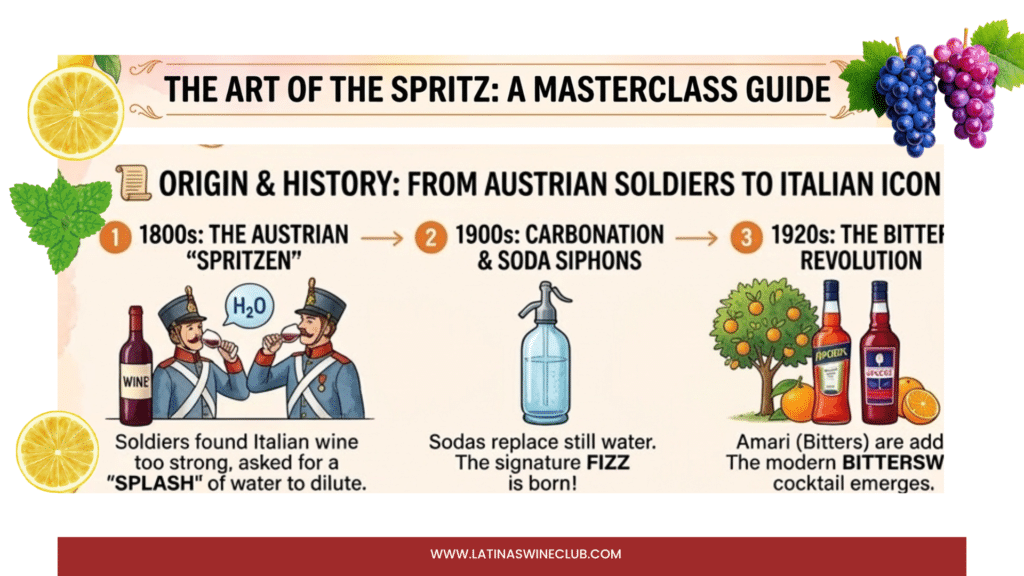
During our class, we took a journey back to the 1800s. To truly appreciate a Spritz, you have to understand that it wasn’t created by a mixologist in a high-end bar—it was a survival tactic.
During the Austrian Empire’s occupation of the Veneto region, soldiers found the local Italian wines (which can reach 12–14% ABV) far too strong compared to the light beers of their homeland. They began asking tavern keepers for a spritzen—a German verb meaning “to spray” or “splash”—to add water and bring the alcohol level down to a “sessionable” 4–5%.
As time moved on, the “splash” evolved. In the early 1900s, the invention of the soda siphon introduced carbonation, turning that splash of water into a splash of bubbles. By the 1920s, with the debut of Aperol and Select, the “bitter” component was added, transforming the drink into the complex, bittersweet botanical cocktail we love today.
The Science of the “3-2-1” Golden Ratio
One of the most common questions I get at the Club is: “Martha, how do I make it taste like it does in Italy?” The secret is the Golden Ratio. While modern bars experiment with different pours, the traditional formula ensures balance every single time:
- 3 Parts Prosecco: Use a Dry or Brut for the best results.
- 2 Parts Bitter or Liqueur: This is where you define the personality of the drink.
- 1 Part Soda Water: The colder, the better!
The Spritz Menu: Beyond the Orange
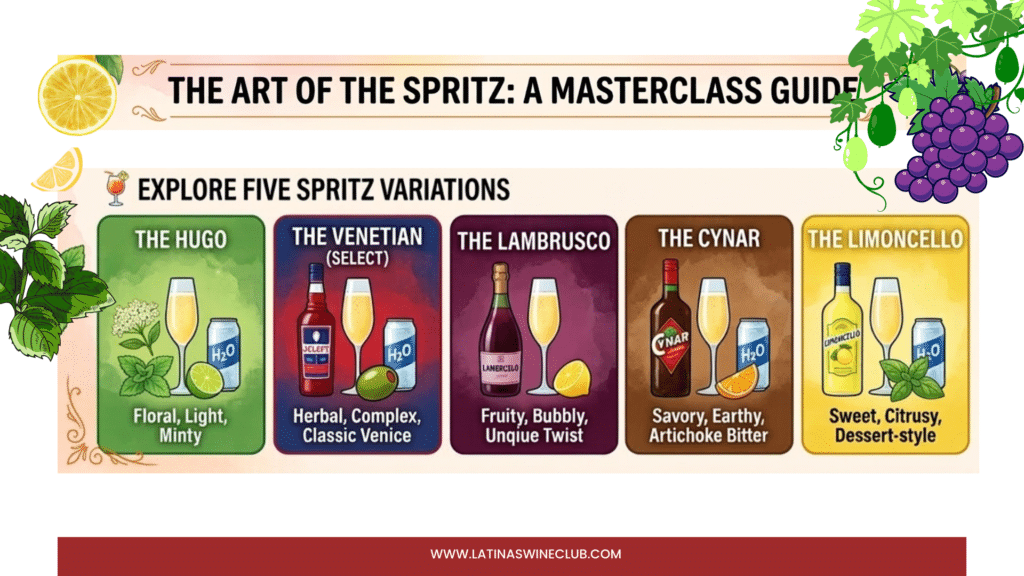
While the Aperol Spritz is the global superstar, our class explored the full spectrum of flavors. Here are the variations we mastered:
- The Hugo Spritz (The Floral Star): This was a crowd favorite! We replaced the bitter amaro with Elderflower Liqueur. The key here is the mint. You must “smack” the leaves between your palms to release the essential oils without making the drink bitter.
- The Venetian (Select Spritz): This is the “true” original from Venice. It’s ruby red, more herbal, and must be served with a large green olive. The saltiness of the olive against the botanicals is a game-changer.
- The Lambrusco Spritz: A nod to our previous Latinos Wine Club sessions! We used a dry (Secco) Lambrusco, proving that red wine has a place in the spritz world too.
- The Cynar Spritz: For those who prefer savory over sweet, this artichoke-based amaro offers an earthy, dark complexity that is incredibly refreshing.
The “Mindful” Cocktail
As we discussed in class, the Spritz is actually the original “Mindful Cocktail.” Because it is built with a high volume of ice and soda water, it naturally paces your alcohol consumption. For those of us who love the social aspect of wine but want to remain present and refreshed, the Spritz is the ultimate tool in the wine lover’s kit.
Martha’s Pro-Tips for the Perfect Pour
- Ice First, Always: Fill your glass to the brim with ice before you start pouring. This keeps the drink from diluting too quickly.
- The “Slow Stir”: Use a long spoon to lift the ingredients from the bottom just once. You want to mix them without killing the bubbles.
- The Garnish is an Ingredient: Whether it’s a lime wheel for your Hugo or a lemon twist for your Lambrusco, the aromatics of the garnish are 50% of the experience.
Further Reading for the Wine Nerds
If you want to dive even deeper into the literature I mentioned during our session, I highly recommend:
- Spritz by Talia Baiocchi and Leslie Pariseau
- The Oxford Companion to Spirits and Cocktails (Edited by David Wondrich)
Are you team Bitter (Aperol/Select) or team Floral (Hugo)? Let me know in the comments or tag us in your spritz photos on Instagram!
Salud, Martha